- +91 7899892496
- info@theflorenceacademy.com

Secondary Stage (Grades 9–12)
The Secondary Stage represents the final phase of school education, where learning becomes more specialized, flexible, and multidisciplinary. At this stage, students are encouraged to explore their interests and strengths while developing a deeper understanding of various academic disciplines. The focus is on preparing students not only for examinations but also for higher education, future careers, and responsible participation in society.
Teaching and learning during this stage emphasize inquiry-based and experiential approaches, where students actively engage with concepts through research projects, presentations, case studies, discussions, and collaborative learning activities. These methods help learners develop the ability to analyze information, evaluate different perspectives, and apply knowledge to real-world situations.
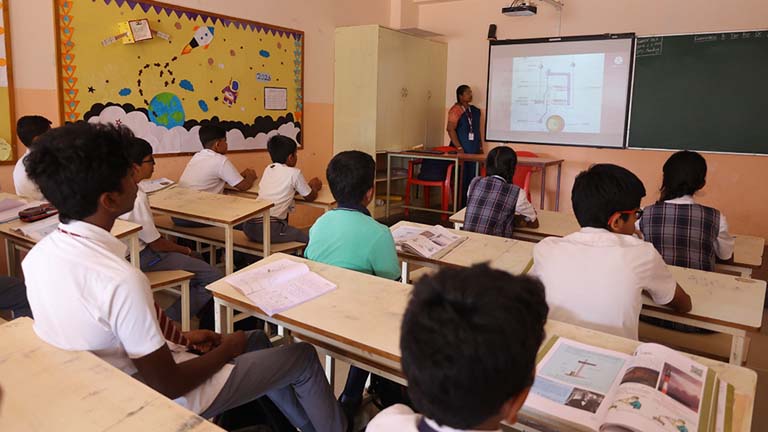
The use of blended learning methods, combining traditional classroom teaching with digital resources and technology-enabled learning, further enhances the learning experience. Students are encouraged to work independently as well as in teams, strengthening their communication, leadership, and problem-solving skills.
Assessment at this stage focuses increasingly on competency-based evaluation, where students demonstrate their understanding through practical application, analytical thinking, and creative expression rather than rote memorization. This approach helps cultivate higher-order thinking skills, critical reasoning, and intellectual curiosity.
Overall, the Secondary Stage equips students with the knowledge, skills, confidence, and adaptability required to succeed in higher education and thrive in an ever-evolving global environment, while fostering a lifelong love for learning.

Florence Academy, Bengaluru, had a noble beginning in the year 2013. Today, its multi-story, beautiful infrastructure is facilitating education for more than 500 students. The school is located in the heart of Electronic City, Bengaluru... read more